Commonly Used Industry Terms
Explaining our business can be somewhat complicated. We’ve created this list of definitions to help demystify some of the terminology encountered in the semiconductor industry.
Analog data
Data that is conveyed via continuous signal. The information content of an analog signal is conveyed by measuring characteristics of the signal, such as the amplitude, phrase or frequency of a voltage. See Digital data.
BiCMOS
Bipolar CMOS. An integrated circuit comprised of a bipolar element and CMOS elements and/or processing. See Bipolar, CMOS.
Bipolar
An electrical device whose operation depends on the transport of both holes (positive charges) and electrons (negative charges). Often used for the “heavy lifting” in electrical operations. Bipolar devices exhibit considerably higher power dissipation than CMOS devices when in the off state because power must be supplied continuously.
Bunny suits
Tightly woven, lightweight, anti-static garments worn by workers in semiconductor fabrication facilities to prevent particulate contamination from getting on the wafer.
CMOS
Complementary metal oxide semiconductor. A semiconductor technology that employs a pair of NMOS and PMOS devices. A metal oxide semiconductor is connected to the outside electrical system by means of a metal oxide-to-silicon bond, which creates a charge in a channel—the so-called channel effect. See N-channel, NMOS, PMOS.
Diffusion
A wafer fabrication process in which a dopant (adjunct) element with either negative- or positive-charged properties is introduced into a semiconductor through high temperature heat treatment or ion implantation.
Digital data
Data that represents a variable that can be represented in integer form. The information content of a discrete signal is concerned with states of the signal, such as absence or presence of voltage or whether a contact is “on” or “off.” See Analog data.
Discrete
An electrical element, or part, individually mounted on a PCB (printed circuit board) and connected to an interconnected wiring system. Usually performs a simple, electrical operation. Manufactured similarly to integrated circuits.
DMOS
Double-diffused-MOS. A second diffusion (or implantation) of a dopant (adjunct) element into the same semiconductor crystal lattice that results in more precision or efficacy of an integrated circuit’s performance. See N-channel, Diffusion.
EPROM
Erasable, programmable read-only memory. A type of non-volatile memory that can be erased (usually with a UV light) and reprogrammed with other instructions or memory in a two-step procedure.
EEPROM
Electrically erasable, programmable read-only memory. A type of non-volatile memory that can be erased electrically (through an electrical interface) and reprogrammed with other instructions or memory in a one-step procedure.
Integrated circuits
Many circuits combined together (integrated) to create a higher function or to create a specific operation in a single element, or part, that is then mounted on a PCB (printed circuit board).
Mask
A pattern of characters superimposed on a wafer to control the retention or elimination of other patterns to create desired circuits and/or electrical connections.
Mixed signal
Implies the use of both analog and digital elements in the same integrated circuit. For example, a cellphone captures your voice (analog) when you speak into it and converts it to a digital stream (A-to-D conversion) for transmission and subsequent manipulation.
MOSFET
Metal oxide semiconductor field-effect transistor. The field-effect is generated by a channel that carries current between the source and drain of the MOSFET. For example, n-channel MOSFET or p-channel MOSFET. See N-channel, P-channel.
N-channel
A metal oxide semiconductor that uses electrons to conduct current in the semiconductor channel that has a predominantly negative charge. Exhibits very low power dissipation when in the off state. (Also called NMOS).
Non-volatile memory
Memory which retains its electrical state (high/low, 1 or 0) even when electrical power is removed from it. See EEPROM, EPROM.
P-channel
A metal oxide semiconductor that uses electrons to conduct current in the semiconductor channel that has a predominantly positive charge (holes). Exhibits very low power dissipation when in the off state. (Also called PMOS).
Semiconductor
An electronic conductor that exhibits semi-conducting properties. It can be induced to conduct electrical current—or insulate /prevent current flow. Also used to refer to a device made from semiconducting material, such as integrated circuits, diodes or chips.
Wafers
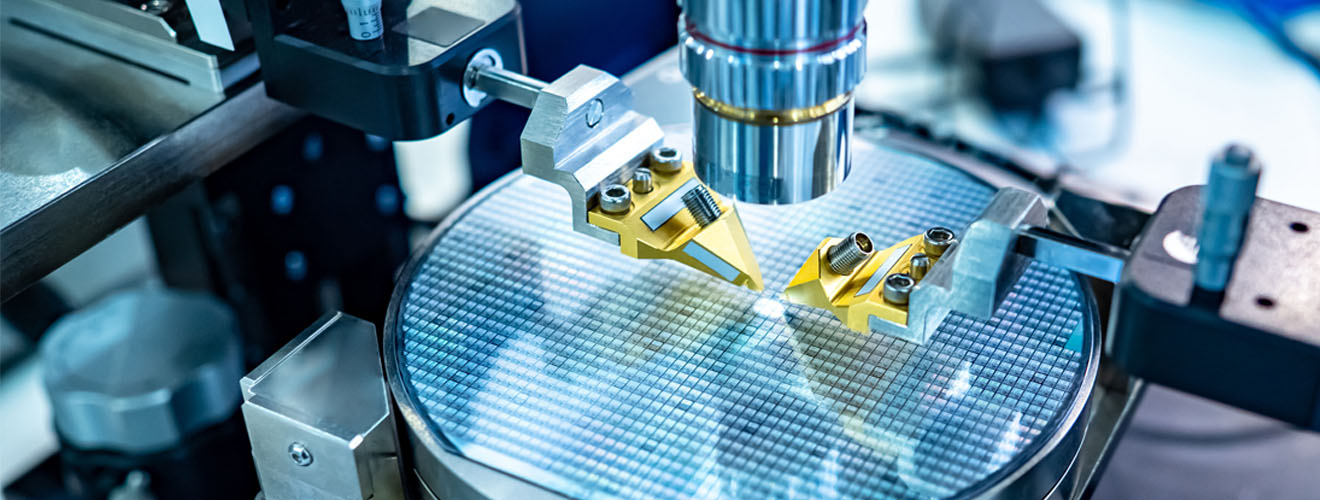
Silicon “disks” on which chips are manufactured. The larger the wafer, the more chips that can be manufactured on the surface. The wafer is cut into individual integrated circuits (chips), which are subsequently placed into a package with metal leads that are soldered to PCBs (printed circuit